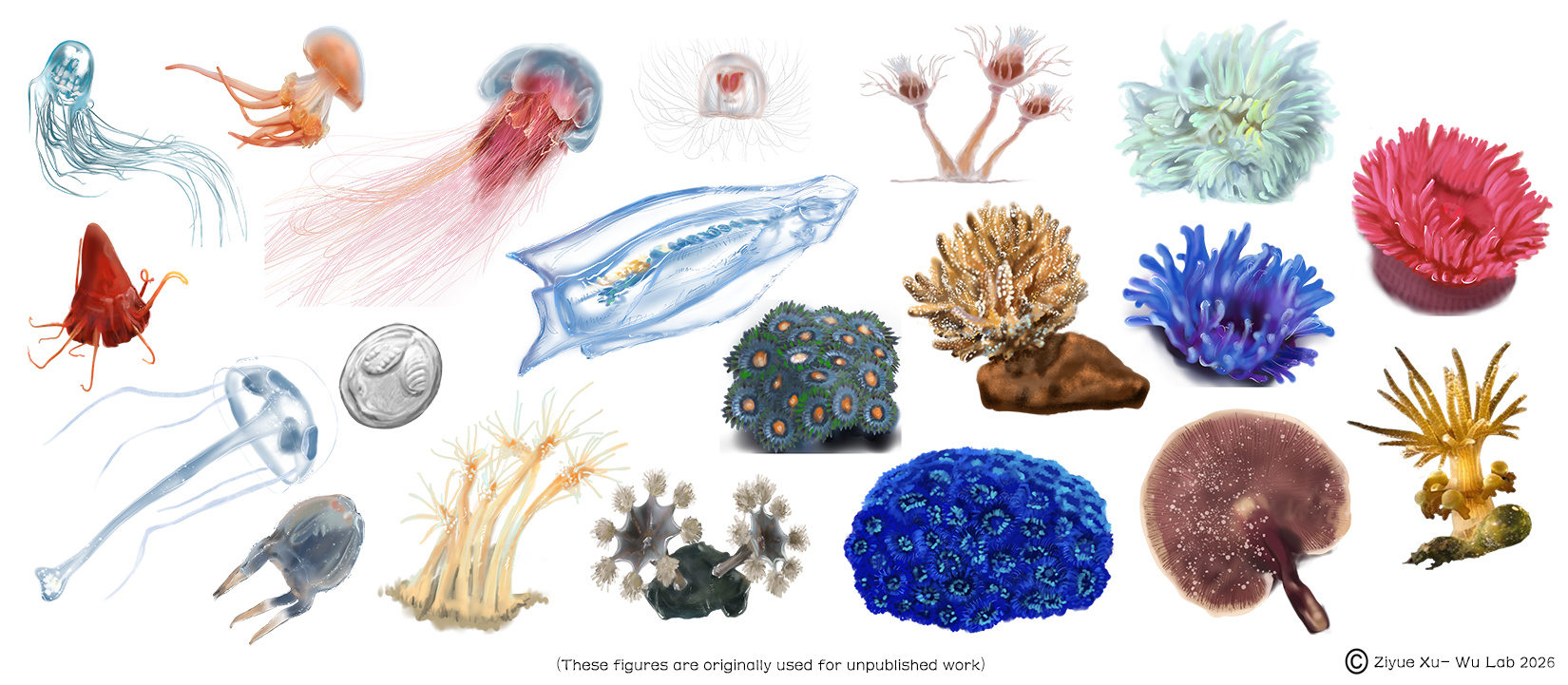
The phylum Cnidaria—comprising corals, jellyfish, sea anemones, and hydroids—are key players in marine ecosystems, yet they face unprecedented decline under climate change, most visibly through mass coral bleaching and disruptive jellyfish blooms, with devastating ecological consequences, including the collapse of reef habitats, loss of marine biodiversity, and disruption of coastal economies. Unravelling the molecular basis of coral thermal tolerance, environmental adaptation, and coral–algal symbiosis has therefore become a pressing global priority in marine environment and conservation research. At the same time, as one of the earliest-branching animal lineages, cnidarians are indispensable for understanding the evolution of multicellularity, the origin of animals, tissue organization, and developmental complexity. Progress in this field, however, has been hampered by the lack of centralized, high-quality multi-omics resources.
To bridge this gap, we present CnidoSite, the first comprehensive, analysis-enabled multi-omics platform dedicated to the phylum Cnidaria. Spanning 325 species across 7 classes, 22 orders, and 107 families, CnidoSite integrates 148 genome assemblies, 15,642 bulk transcriptomes, 33 single-cell datasets, 46 proteomes, 723 epigenomes, 1,650 metagenomic samples, and 151,046 phenotype records (including bleaching traits and thermal tolerance), complemented by advanced toolkits for functional and comparative analyses from a multidimensional perspective. Functional genomic resources—including genome assemblies, genome phylogenies, fossil entries, functional annotations, BUSCO genes, and single-cell and mitochondrial annotations—are also provided. The platform further features 31 co-expression networks with cross-tissue expression views and a high-resolution single-cell atlas with curated cell markers, mapping developmental and stress-responsive landscapes.
In summary, CnidoSite serves as a centralized, analysis-ready resource for addressing key scientific questions—including coral bleaching, symbiosis breakdown, jellyfish blooms, environmental adaptation, and evolution—that sit at the intersection of cnidarian biology, marine conservation, comparative genomics, and evolutionary biology. The website is freely accessible to all users, without login or registration.
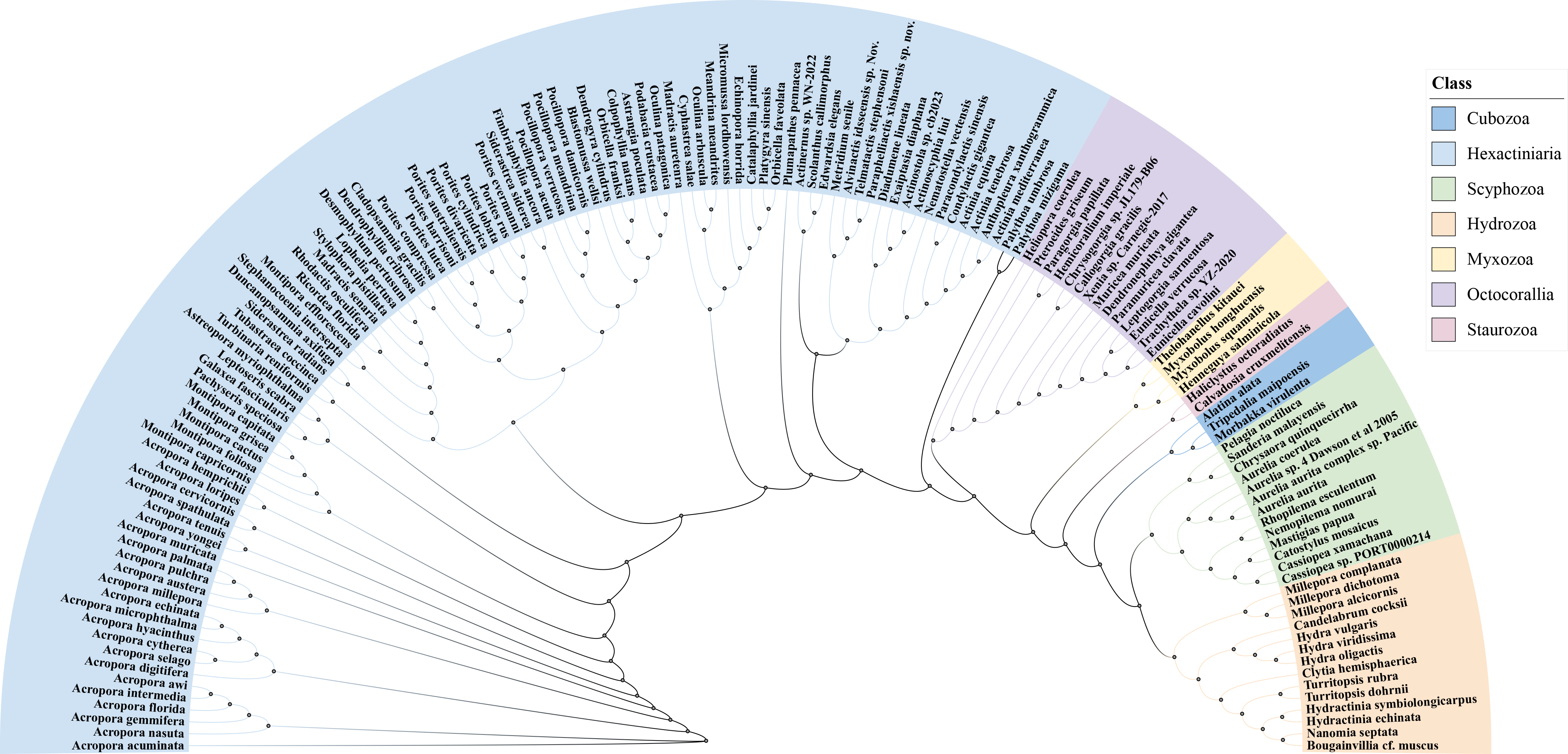
Phylogenetic relationships of cnidarian species included in CnidoSite database.
For data inquiries, collaborations, or technical support, please contact our team:
longjunwu@ust.hk
boqianpy@ust.hk
jackieyihkb@ust.hk
Learn more about our research: LongJun Wu's Lab | Pei-Yuan QIAN's Lab
- Class/Order/Family/Species 7/22/107/325
- Assembled/Fully Annotated Genomes 148/145
- Transcriptomic Datasets 15,642
- Single-Cell Datasets 33
- Proteomic Datasets 46
- Epigenomic Datasets 723
- Metagenome Datasets 1,650
- Phenotype Datasets 151,046
- Mitochondrial Datasets 151
- Fossil Records 410
- Protein-Coding Genes 5,450,036
- Busco Genes 542,399
- Co-Expressed Network31
- Co-Expressed Gene Pairs 13,793,211
- Cell Types 206
- Cell Markers 297,645
- Quantified Proteins 83,306
- Epigenetic Modification Type 13
- Epigenetic Modification Peaks 739,820,475
- Metagenome-Assembled Genomes 315
- Type of Gene Annotation 9
- NR Database 89,363,242
- UniProt Database 140,368,972
- KEGG Pathways 1,362,980
- Transcription Factors 96,854
- Ubiquitin Family 306,859
- Gene Ontology 36,073,035
- Interpro Annotation 35,694,300
- Pfam Domain 7,479,863
- PANTHER 3,805,615
- Gene Family 3,621,064
- 2026-05-28: Mitochondrial datasets enabled
- 2026-05-26: Pan-geneset analysis enabled
- 2026-05-24: Species description enabled
- 2026-05-20: Cnidaria phylogeny available
- 2026-05-14: Phenotype datasets enabled
- 2026-05-10: Multi-Omics pages are available
- 2026-04-20: Dynamic network view added
- 2026-04-07: Enrichment analysis available
- 2026-04-05: BLAST search tool integrated
- 2026-04-04: Taxonomic browsing implemented
- 2026-03-02: Co-expression networks available
- 2026-02-19: Primer design tool added
- 2026-01-29: JBrowse visualization deployed
- 2025-12-28: Fossil record integration completed
- 2025-11-18: CnidoSite initial release