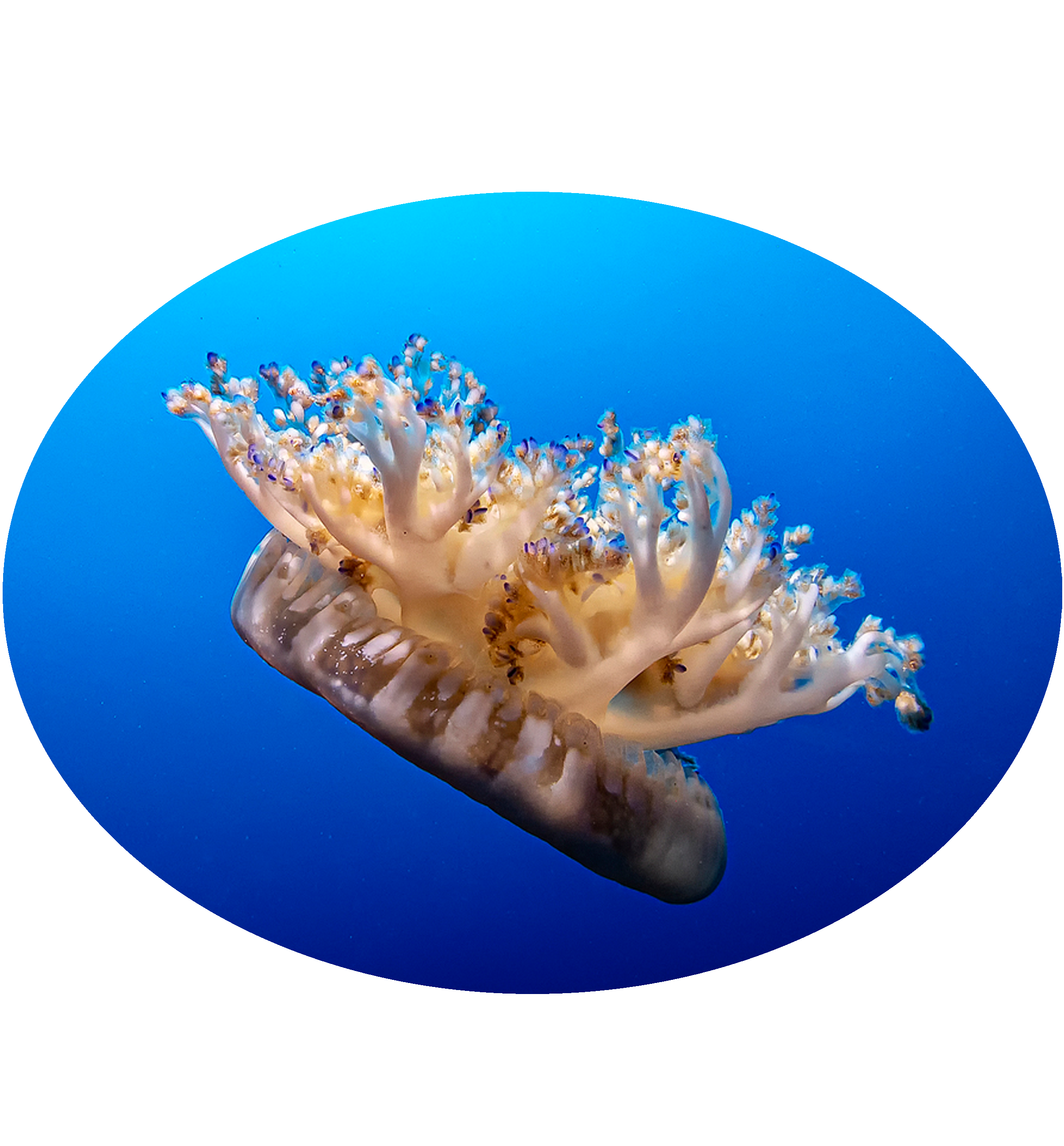
Cassiopea andromeda, the upside-down jellyfish (family Cassiopeidae), is distributed across shallow, warm coastal waters of the Indo-Pacific, resting bell-side down on sandy or muddy substrates and exposing its highly branched oral arms to sunlight to maximize photosynthesis by its endosymbiotic Symbiodiniaceae. The species produces a mucus cloud containing stinging cassiosomes that can cause dermatological reactions in swimmers without direct contact. A genome has been assembled for C. Cassiopea species are increasingly studied as models for cnidarian sleep-like states and photobiology.
| Class | Species | NCBI Taxonomy ID | Assembly Level | GenBank Assembly | Assembly Name | Genome Size (Mb) | WGS Accession | Submitter | BioProject |
|---|---|---|---|---|---|---|---|---|---|
| Scyphozoa | Cassiopea andromeda | 114796 | Scaffold | GCA_018155075.1 | ASM1815507v1 | 387.8 | WIPJ01 | University Medical Center Groningen (UMCG) | PRJNA576371 |
| Chromosome Number | Scaffold Number | Contig Number | Protein Number | Protein-Coding Gene Number | Contig N50 | Scaffold N50 | GC content (%) | BUSCO completeness |
|---|---|---|---|---|---|---|---|---|
| - | 101352 | 132660 | 35,027 | 35,027 | 16678 | 307826 | 37 | 80.80% |
| Title | Journal | Pubmed ID |
|---|---|---|
| Trends in nematocyst abundance provide a mechanism for venom metering in the 'upside-down' jellyfish Cassiopea | Journal of Experimental Marine Biology and Ecology | Link |