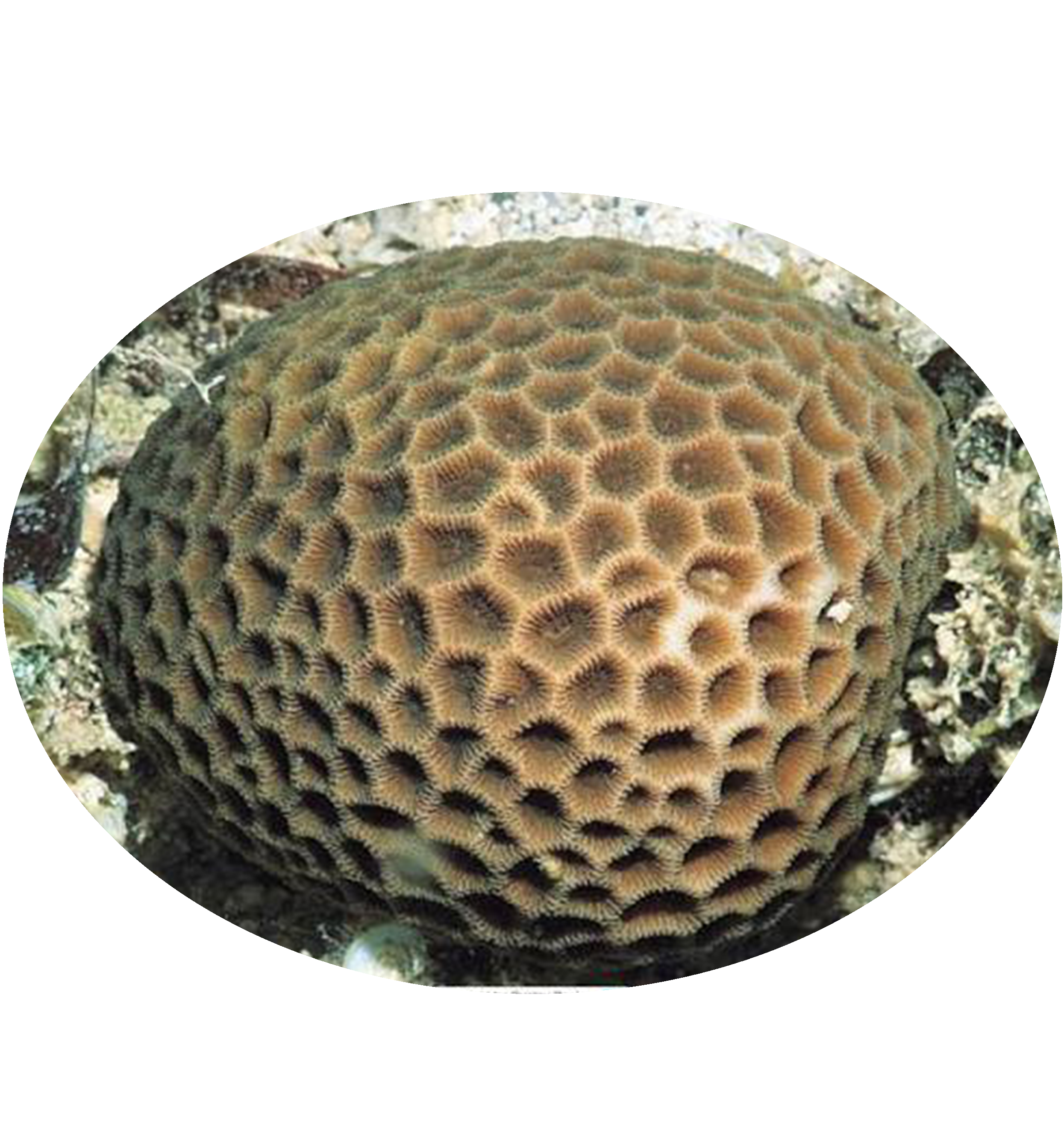
Coelastrea aspera is a colonial, hermatypic scleractinian coral (family Merulinidae) widely distributed across shallow, wave-sheltered or high-sediment reef flats, lagoons, and intertidal rocky shores throughout the Indo-Pacific region. Morphologically, it typically forms massive, encrusting, or subhemispherical colonies characterized by a distinctive cerioid corallite arrangement, where adjacent corallites share fused, common walls. The corallites are relatively small, polygonal (often angular or subquadrate), and feature deep calices with high, sharply defined septa that impart a notably rough, textured appearance to the skeletal surface. Living colonies exhibit a range of dull colorations, predominantly shades of pale brown, grey-green, or brownish-yellow, frequently displaying contrasting pale or vibrant green oral discs. Characterized by an environmental tolerance for extreme conditions, C. aspera is a broadcast spawning species that synchronizedly releases gametes into the water column for external fertilization and subsequent planktonic planula larval development. As a resilient and ecologically vital reef-building component, this species possesses an exceptional capability to withstand high solar radiation, temperature fluctuations, and heavy sedimentation, making it a dominant and highly competitive pioneer organism in challenging intertidal zones and degraded coral reef habitats