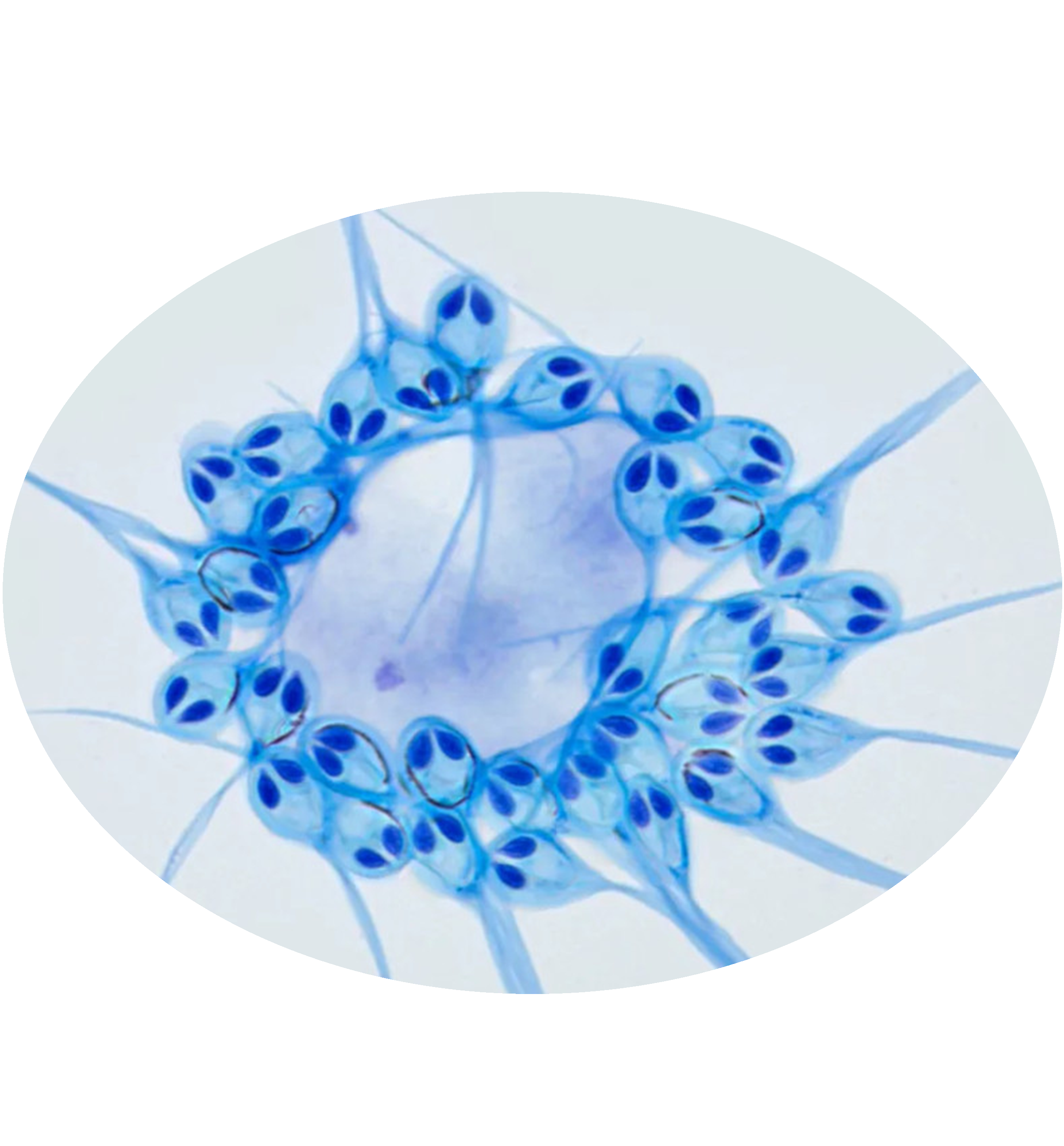
Henneguya salminicola is a myxozoan parasite (family Myxobolidae) of salmonid fish in the Pacific Northwest of North America, famous for being the first described multicellular animal known to lack a mitochondrial genome—a landmark 2020 finding revealing it has completely lost the capacity for aerobic respiration and survives by parasitizing its host's mitochondria. This species is of profound significance to evolutionary biology as an extreme example of genomic and metabolic reduction driven by obligate parasitism.
| Class | Species | NCBI Taxonomy ID | Assembly Level | GenBank Assembly | Assembly Name | Genome Size (Mb) | WGS Accession | Submitter | BioProject |
|---|---|---|---|---|---|---|---|---|---|
| Myxozoa | Henneguya salminicola | 69463 | Scaffold | GCA_009887335.1 | TAU_Hsal_1 | 58.6 | SGJC01 | Tel-Aviv University | PRJNA485580 |
| Chromosome Number | Scaffold Number | Contig Number | Protein Number | Protein-Coding Gene Number | Contig N50 | Scaffold N50 | GC content (%) | BUSCO completeness |
|---|---|---|---|---|---|---|---|---|
| - | 18330 | 18332 | 8188 | 8187 | 7570 | 7570 | 29 | C:9.0%[S:8.9%,D:0.1%],F:2.3%,M:88.7% |
| Title | Journal | Pubmed ID |
|---|---|---|
| A cnidarian parasite of salmon (Myxozoa: Henneguya) lacks a mitochondrial genome | PNAS | 32094163 |