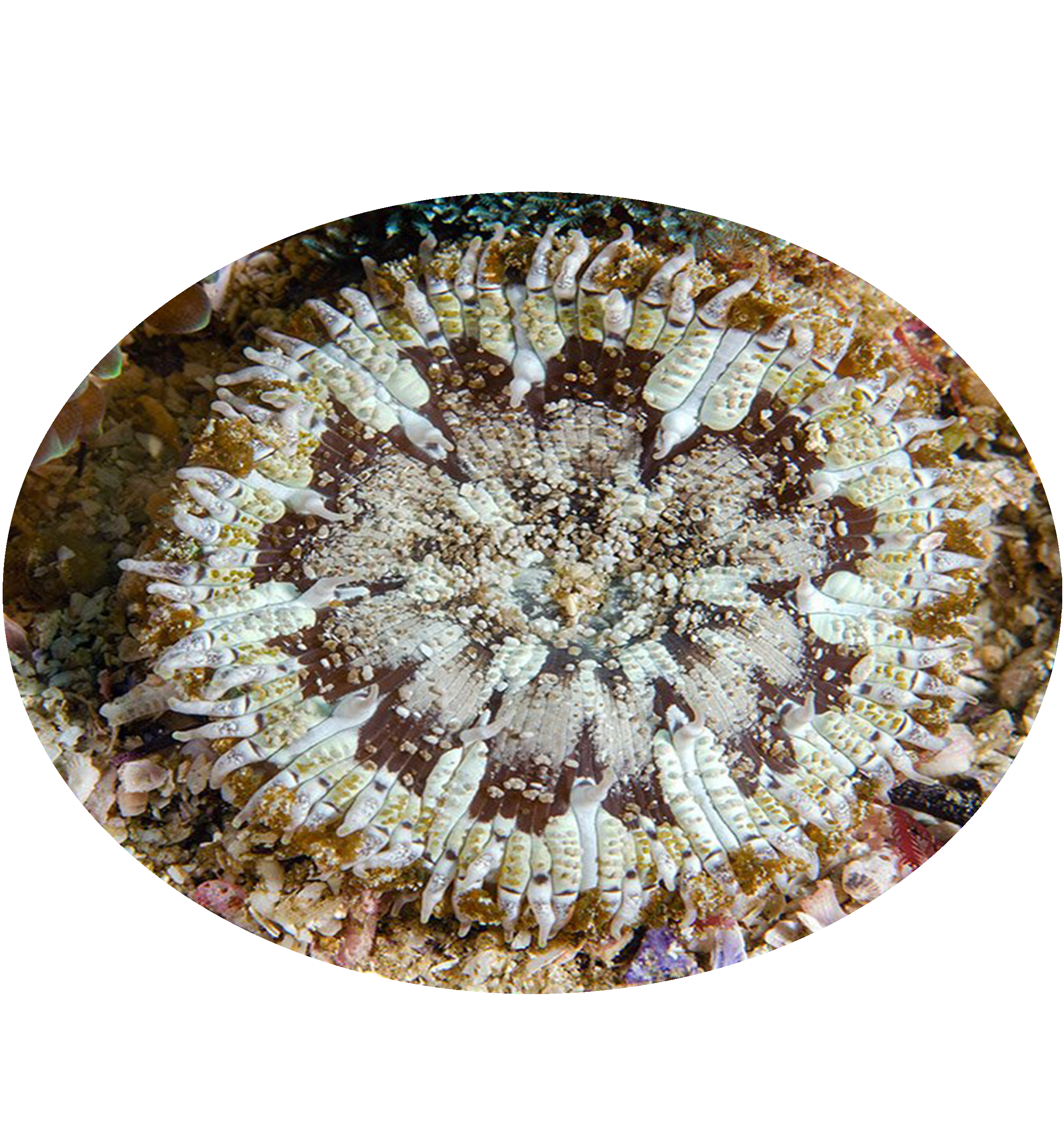
Heteranthus verruculatus is a small, highly camouflaged sand-dwelling sea anemone (family Heteranthidae) widely distributed throughout the intertidal and subtidal zones of the Indo-West Pacific and the Red Sea. Morphologically, this species is relatively small, with an oral disc diameter typically under 25 to 75 mm, varying in coloration from dark olive green and greenish-brown to deep sepia. The species displays a distinct dimorphic tentacle arrangement: the marginal tentacles are smooth, pointed, and elongated, while the discal tentacles covering the upper oral disc are modified into inconspicuous, papilliform (wart-like) or knob-like structures. Its column is densely embedded with adhesive verrucae (suckers), enabling the animal to attach its pedal disc to buried coral rubble, rocks, or seagrass roots, while accumulating sand grains for physical protection and crypsis. Economically and ecologically, H. verruculatus hosts endosymbiotic zooxanthellae for autotrophic energy supplement and exhibits a notable propensity for frequent asexual reproduction via longitudinal fission, which often results in irregular clonal clusters and asymmetrical body plans within localized benthic microhabitats.