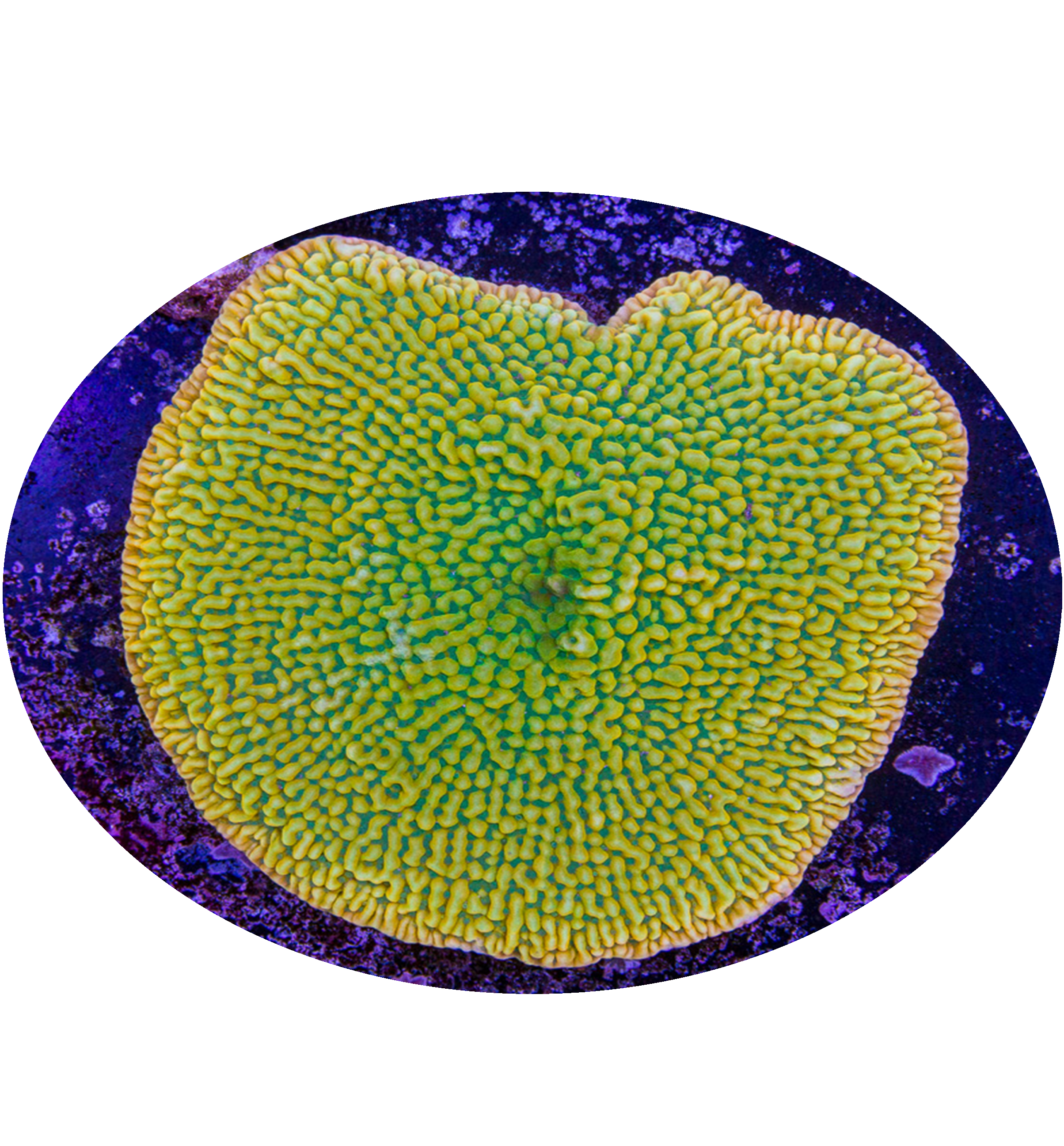
Montipora palawanensis is a distinctive, slow-growing small polyp stony (SPS) coral (family Acroporidae) restricted to the shallow, wave-exposed upper reef slopes across the tropical Indo-West Pacific. Morphologically, the species forms robust submassive, encrusting, or laminar/plating colonies that are visually dominated by remarkably large, prominent verrucae uniformly covering the coenosteum surface. These dome-shaped verrucae systematically fuse together into continuous, irregular ridges, creating a deeply textured, maze-like or gyrate skeletal topography. Individual corallites are deeply immersed and hidden within the valleys between these highly elevated ridges, only aligning in neat, parallel rows along the very edge of thin laminar plates. Naturally found in shades of uniform brown or deep blue, M. palawanensis exhibits high cellular plasticity, yielding celebrated aquacultured strains like the "Kung Pao" and "Beach Bum," which display striking combinations of iridescent golden-orange coenosteum contrasted by bright neon-green or cyan polyps. Ecologically, this species relies heavily on its obligate phototrophic symbiosis with endosymbiotic dinoflagellates (zooxanthellae) and serves as an important, albeit uncommon, structural contributor to complex benthic reef ecosystems.