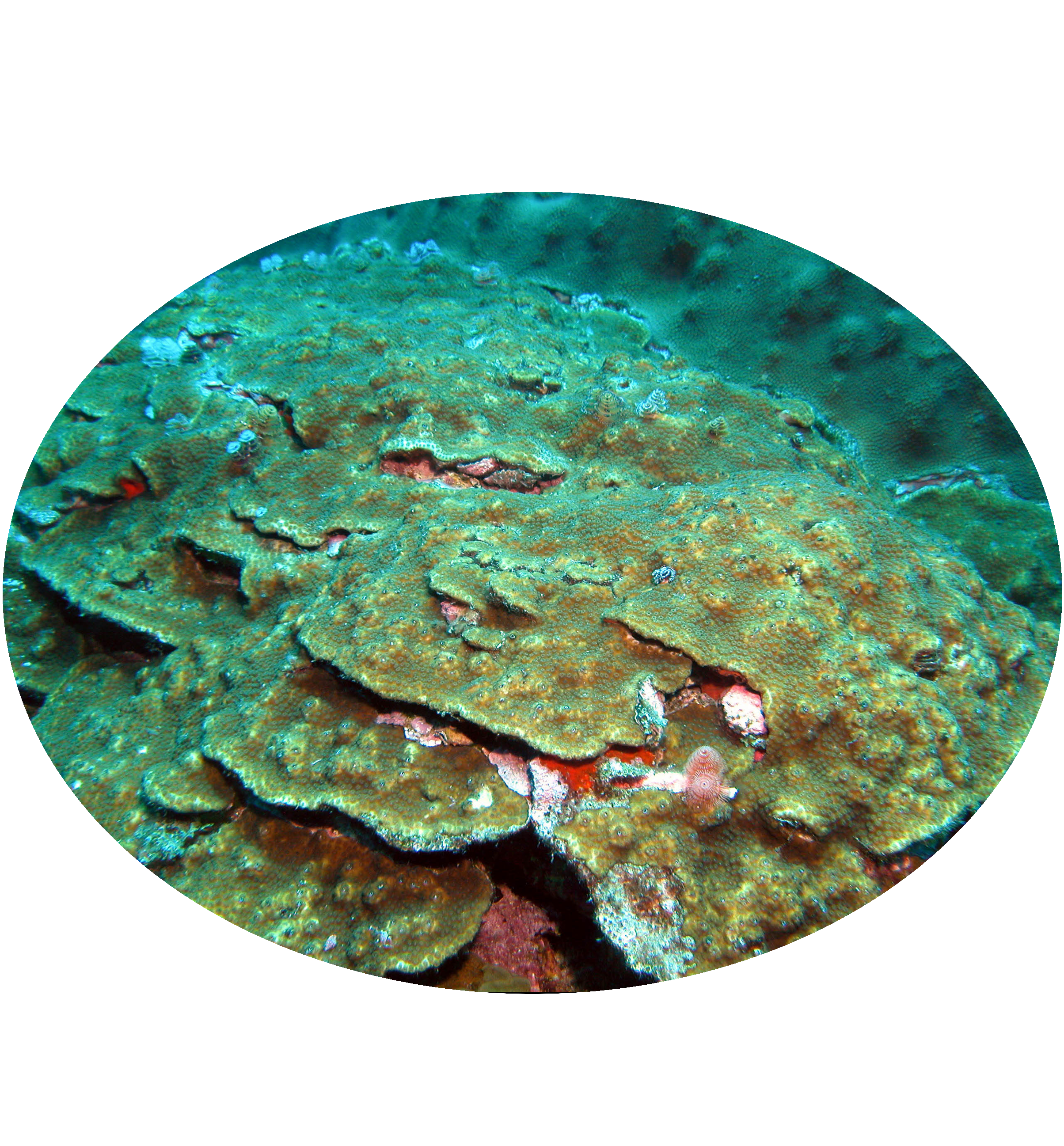
Orbicella franksi is a massive, slow-growing, and long-lived scleractinian coral (family Merulinidae) that acts as a vital primary framework builder across shallow and mesophotic reef systems throughout the Caribbean Sea, the Gulf of Mexico, and adjacent western Atlantic waters. Morphologically, it forms robust, irregular boulder-like or encrusting colonies that can exceed multiple meters in diameter. The colonial surface is characteristically bumpy and uneven, adorned with scattered mounds, ridges, or white patch-like growth anomalies that distinguish it from its congeneric relatives. Individual corallites are plocoid, circular to conical, measuring approximately 2.5 to 4.0 mm in diameter, and are irregularly distributed across the colony with strongly developed, heavily exsert and dentated septo-costae. Coloration of the living tissue is highly mottled, ranging from greenish-brown and mottled orange to yellowish-brown, often punctuated with pale or unpigmented growing tips. Ecologically, O. franksi maintains an obligate mutualistic symbiosis with photosynthetic dinoflagellates (Symbiodiniaceae) to fulfill its autotrophic energy requirements.