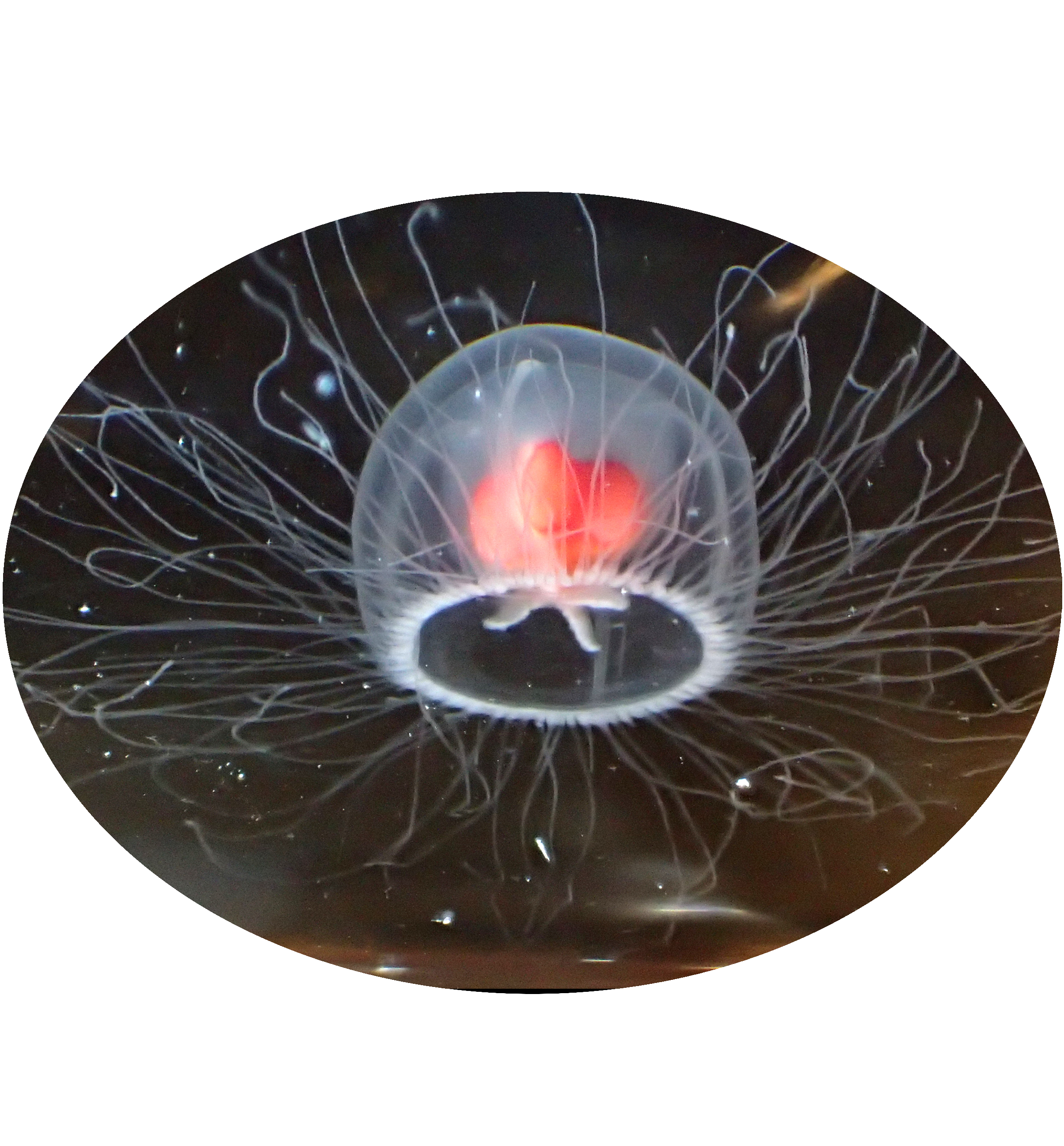
Turritopsis rubra is a small, coastal hydromedusa (family Oceaniidae) native to the shallow, wave-exposed neritic waters of New Zealand and southern Australia. Morphologically, the adult medusa is tiny and bell-shaped, measuring up to 7 mm in height, and features a transparent exumbrella that vividly displays an intensively crimson-red cruciform stomach and gonads within the bell cavity. The subumbrella margin anchors a dense, crowded arrangement of up to 120 simple tentacles originating from distinct, closely spaced tentacle bulbs equipped with light-sensitive adaxial ocelli. Unlike its globally renowned congener Turritopsis dohrnii (the "immortal jellyfish"), mature medusae of T. rubra lack the robust biological immortality phenotype to successfully undergo life cycle reversion back into a juvenile polyp under physiological stress. Genomically, its fully decoded chromosome-level reference framework serves as a critical evolutionary baseline; comparative genomic mapping has revealed that T. rubra possesses significantly fewer duplication variants of DNA repair polymerases, telomere maintenance pathways, and oxidative stress mitigation coding matrices compared to T. dohrnii. Furthermore, T. rubra displays a specialized reproductive ecology, utilizing gonochoristic fertilization where females exhibit a brooding habit, retaining fertilized eggs internally until they develop into ciliated planula larvae before ocean dispersal.