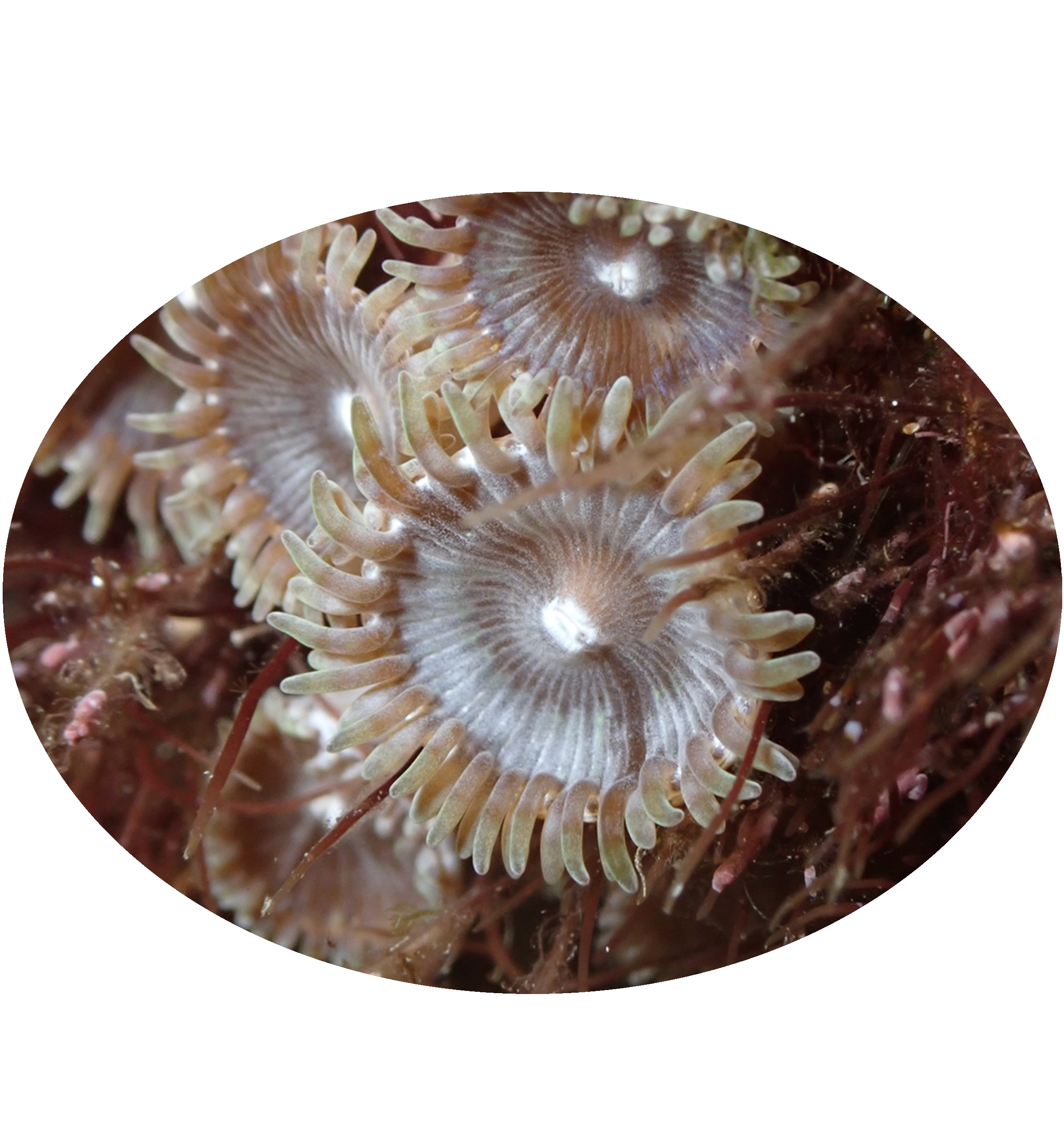
Zoanthus pulchellus is a highly colonial, photosynthetic zoanthid (family Zoanthidae) widely distributed across intertidal and shallow subtidal rocky shores, rubble zones, and reef flats within the tropical Western Atlantic, Caribbean Sea, and parts of the Indo-Pacific. Morphologically, the species is characterized by forming exceptionally dense, compact mat-like clonal colonies (sea mats) where individual columnar polyps press tightly against one another. The polyps are relatively short to moderately elongated, typically ranging from 4 to 30 mm (occasionally reaching 50 mm) in height and 4 to 15 mm in diameter, with a circular to polygonal cross-section when fully expanded. The oral disc exhibits broad chromatic variations, frequently displaying shades of yellowish-green, fluorescent green, bluish-purple, or brown, and is fringed by a double row of 60 to 70 short, blunt marginal tentacles. Unlike the related genus Palythoa, the tissue architecture of Z. pulchellus completely lacks sand or sediment encrustation within its coenenchyme and mesoglea. Ecologically, it maintains an obligate photo-symbiosis with endosymbiotic zooxanthellae for primary carbon fixation. Genomically, Z. pulchellus has been successfully sequenced via short-read platforms (suborder Brachycnemina initiative), providing an important baseline assembly to investigate transposable element (TE) landscapes, the evolutionary dynamics of repeatome expansion, and the biosynthesis of complex marine alkaloids such as norzoanthamine.